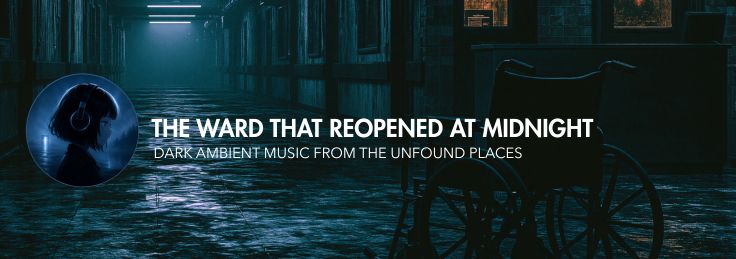
UF-002 — North Isolation Ward
Facility type: Industrial medical research hospital
Closure status: Permanent
Years inactive: Fourteen
Signal status: ActiveRoom 031 showed a pulse. No patient was visible.
Dark Ambient Hospital Music from North Isolation Ward
At exactly midnight, power returned to North Isolation Ward.
The fluorescent lights did not switch on at once.
They activated one by one, beginning at the entrance and moving gradually toward the sealed rooms at the end of the corridor.
The hospital had been closed for fourteen years.
Its external power supply had been disconnected.
No emergency system should have remained operational.
At 00:07, a heart monitor inside Room 031 began registering a pulse.
No patient was visible through the observation window.
At 00:31, the ward resumed admitting new patients.
The Ward That Reopened at Midnight is a 30-minute dark ambient hospital music experience by Wartonno Sound. It is the second recovered location from The Unfound Places, a connected series of soundscapes, impossible architecture, quiet horror, and places absent from ordinary maps.
This is not a hospital designed to heal.
It is a ward that continued working after everyone had left.
What is The Ward That Reopened at Midnight?
The Ward That Reopened at Midnight combines dark ambient music, abandoned hospital atmosphere, cinematic imagery, environmental sound, and a fragment of connected liminal lore.
The experience takes place inside North Isolation Ward, a sealed section of an industrial medical research hospital.
The hospital officially closed fourteen years ago.
According to the available records:
- All patients had been transferred.
- All medical equipment had been removed or deactivated.
- The isolation ward had been permanently sealed.
- The building had no active electrical supply.
- No staff had entered North Isolation Ward since the closure.
That changed at midnight.
The corridor lights returned.
The ventilation system restarted.
The patient-call panel activated.
A heart monitor inside Room 031 began detecting a steady pulse.
The ward did not appear abandoned anymore.
It appeared to be waiting.
Listen to The Ward That Reopened at Midnight
Keep the room quiet.
Let the corridor remain open for thirty minutes.Headphones are recommended for the full environmental detail.
Dark ambient hospital music from a ward left behind
Hospital environments already contain their own kind of music.
Ventilation systems breathe through hidden walls.
Fluorescent lights create a thin electrical note above the corridor.
Monitors repeat simple patterns.
Metal trolleys resonate when their wheels cross uneven flooring.
Distant doors close with long, clinical reverberation.
In an occupied hospital, these sounds disappear beneath voices, footsteps, alarms, and constant movement.
In an abandoned hospital, the building becomes audible.
The music in The Ward That Reopened at Midnight draws from that quiet clinical language.
The soundscape may include:
- low industrial drones
- fluorescent electrical hum
- restrained heart-monitor pulses
- degraded ambient pads
- distant intercom textures
- metallic trolley resonance
- oxygen-system hiss
- sparse piano fragments
- long sterile reverberation
- subtle security-camera interference
The piece does not behave like a conventional horror soundtrack.
It does not rely on sudden shocks or constant escalation.
Instead, the atmosphere unfolds slowly.
At first, the ward seems empty.
Then systems begin responding.
A monitor activates.
An announcement appears beneath the music.
Something rolls through a corridor beyond the camera’s view.
The deeper the listener enters the piece, the less certain the hospital’s emptiness becomes.
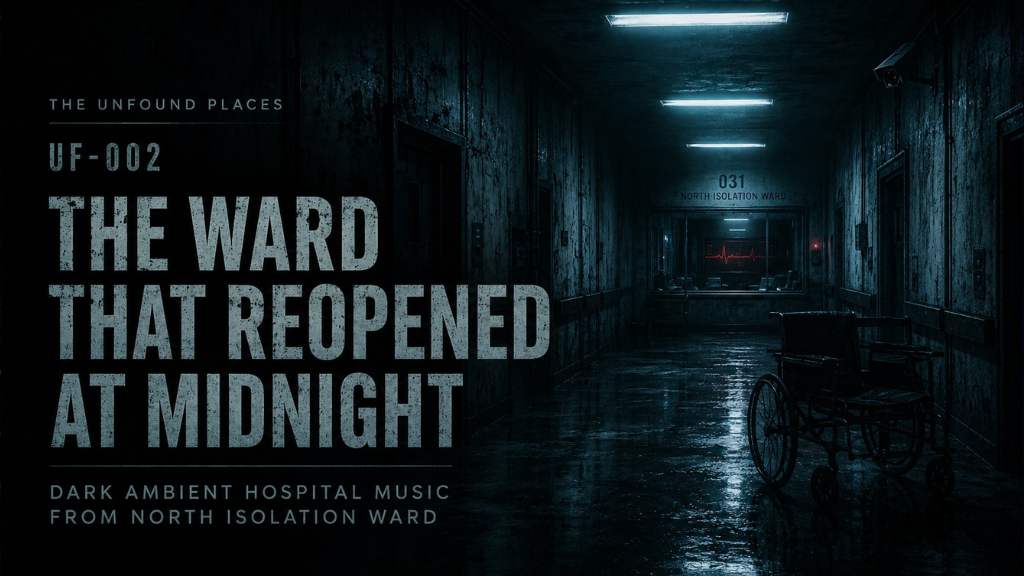
Room 031 is occupied
Room 031 is the centre of UF-002.
The observation window shows an empty hospital bed.
No movement is visible.
The heart monitor continues registering a pulse.
Investigators entering the room found:
- an empty bed
- an inactive infusion stand
- a disconnected oxygen line
- a patient chart on the bedside table
- a heart monitor receiving no identifiable biological input
The chart listed Patient 031.
The discharge date was fourteen years earlier—the same night the hospital permanently closed.
No admission date was recorded.
No patient name was included.
Only the room number remained.
The monitor continued detecting a pulse for another six hours.
Invisible patients and midnight admissions
At 00:31, the admissions system restarted.
The terminal at the abandoned nurse station began producing patient files.
No one was using the keyboard.
No patients had entered the building.
The files contained room assignments, treatment codes, and observation instructions.
Several details were missing:
- patient names
- dates of birth
- contact information
- medical history
- signatures
Each file included a time of arrival.
Security cameras showed no one entering through the hospital doors.
The patient-call system began lighting up above rooms that remained physically empty.
One by one, the ward responded as though beds were becoming occupied.
The machines behaved as if patients were present.
The cameras did not agree.
Staff visible only on surveillance footage
At 01:12, hospital staff began appearing on the security monitors.
They moved calmly through the corridor.
Some carried files.
Others pushed medical trolleys.
One figure stopped outside Room 031 and appeared to check the patient chart.
No staff could be seen inside the actual ward.
Investigators standing in the corridor watched the same camera feed in real time.
The monitors showed people moving around them.
The corridor itself remained empty.
When the surveillance recordings were reviewed later, none of the investigators appeared in the footage.
Only the staff remained.
Why abandoned hospitals feel uniquely liminal
Hospitals are places of transition.
People enter because something has changed.
They wait for a diagnosis, recovery, surgery, birth, discharge, or news that may divide their life into a before and an after.
Their architecture reflects this transitional function:
- long corridors
- observation windows
- waiting rooms
- numbered doors
- elevators between restricted floors
- rooms designed for temporary occupation
- signs directing people toward spaces they may fear entering
When a hospital becomes empty, that purpose does not disappear.
The corridors still lead somewhere.
The lights still suggest activity.
The rooms still appear prepared for someone.
The building continues carrying the shape of care, urgency, fear, and waiting—but without the people who gave those systems meaning.
This contradiction makes the abandoned hospital one of the strongest forms of liminal space.
It looks ready to function.
It only lacks the living.
A dark ambient listening space for reading and writing
Although UF-002 contains clinical unease, the composition is built as a long-form listening experience rather than a conventional horror sequence.
It may be especially useful for:
Reading horror and speculative fiction
The restrained pacing can support psychological horror, weird fiction, medical thrillers, science fiction, urban fantasy, and stories involving abandoned institutions.
Writing and worldbuilding
The soundscape can provide atmosphere while writing hospital scenes, research facilities, impossible architecture, hidden wards, or characters investigating institutional mysteries.
Deep focus
The absence of conventional percussion and prominent vocals allows the music to create an environment without repeatedly demanding attention.
Overthinking nights
The repeated environmental textures give the mind a fixed place to rest.
A corridor.
A distant monitor.
A slow electrical hum.
The music does not promise to silence thought. It simply offers it a quieter architecture.
Sleep for darker ambient listeners
Listeners comfortable with hospital ambience, low drones, and subtle unease may use the piece while winding down or drifting toward sleep.
The track remains restrained, but its clinical atmosphere may not suit listeners who prefer warm or traditionally soothing sleep music.
A thirty-minute hospital listening ritual
You can use the episode as a simple listening ritual.
- Lower the lighting in your room.
- Put the video on at a comfortable volume.
- Begin reading, writing, drawing, or resting.
- Let the environmental details emerge without actively searching for them.
- Return your attention to the corridor near the end.
The visual does not require constant watching.
The ward can remain in the background.
Its lights continue turning on.
The monitor continues showing a pulse.
The corridor remains open whether you are watching it or not.
The wristband recovered from UF-001
North Isolation Ward was not discovered through hospital records.
It was identified through an object recovered from UF-001: The Room Appeared.
Inside the impossible surveillance room, investigators found a hospital wristband marked:
PATIENT 031
NORTH ISOLATION WARD
The hospital name was missing.
The ward did not initially appear in any active medical database.
A search through archived industrial-property records eventually identified a closed medical research facility with a sealed northern wing.
When investigators reached the hospital, Room 031 was already active.
The wristband had led them to a patient who had supposedly been discharged fourteen years earlier.
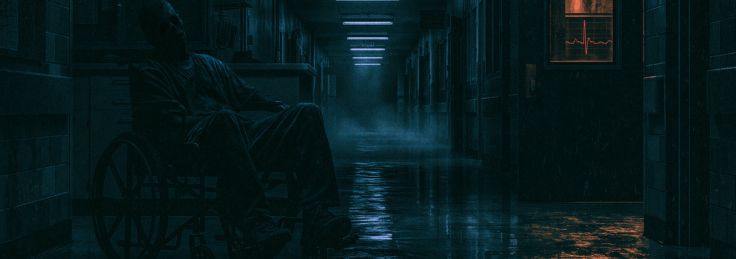
Objects recovered from North Isolation Ward
Several items found inside UF-002 may connect to future locations.
The employee badge
A shopping-centre employee badge was discovered beneath the bed in Room 031.
The photograph had been removed.
The badge granted access to a location called Lower Concourse B.
The receipt
A café receipt was found inside the patient chart.
Its timestamp was three years after the shopping centre named on the receipt had been demolished.
The directory fragment
A damaged directory listed retail units, service corridors, and an underground concourse not included on the original building plans.
The cassette
A cassette labelled LOWER CONCOURSE was found inside an admissions drawer.
The tape contained twenty-two minutes of shopping-centre ambience.
Near the end, an overhead announcement could be heard:
The lower concourse will close in ten minutes.
The announcement repeated for several hours.
The connection to the next Unfound Place
The objects inside UF-002 point toward a closed shopping centre.
The centre does not appear in current municipal records.
Its upper levels were demolished.
The lower concourse may still exist.
Future classification:
UF-003 — The Lower Concourse Is Still Open
The connection does not need to be understood before listening to UF-002.
Each episode of The Unfound Places stands alone.
The clues are there for listeners who choose to follow them.
What is The Unfound Places?
The Unfound Places is a connected Wartonno Sound series exploring locations that should not exist.
Each 30-minute episode combines:
- dark ambient music
- liminal environments
- environmental sound
- cinematic visual storytelling
- brief opening and closing transmissions
- recurring objects and unresolved clues
The locations may include:
- abandoned research facilities
- hospitals after midnight
- industrial complexes
- closed shopping centres
- Backrooms-inspired structures
- impossible rooms
- undocumented corridors
- places visible only through surveillance systems
The series is designed so that every episode can be heard independently.
The music remains the main experience.
The larger story is optional.
You can simply enter the location and listen.
Or you can follow the evidence.
The sound of a functioning empty building
The central tension of UF-002 is not that the hospital is dead.
It is that the hospital appears alive.
Its systems are working.
Its staff are visible.
Its patients are being admitted.
Its monitors are receiving signals.
Everything required for the ward to function has returned—except the people who should be there.
That is where dark ambient hospital music becomes especially effective.
It does not need to explain what happened.
It only needs to let the building continue.
A light switches on.
A machine begins measuring something.
A distant voice asks for assistance.
The corridor remains empty.
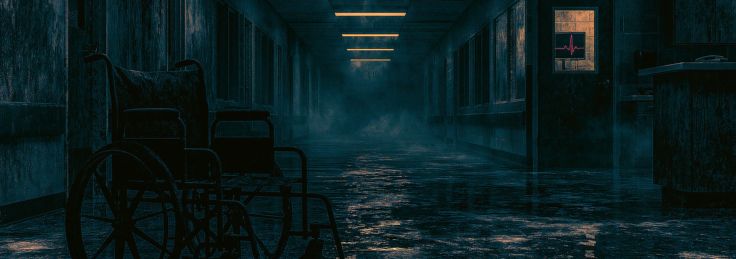
Episode record
Series: The Unfound Places
Episode: UF-002
Title: The Ward That Reopened at Midnight
Location: North Isolation Ward
Facility type: Industrial medical research hospital
Room: 031
Hospital status: Closed
Years inactive: Fourteen
Ward status: Open
Artist: Wartonno Sound
Format: 30-minute dark ambient hospital music
Signal status: Active
Enter North Isolation Ward
At midnight, the ward reopened.
At 00:07, Room 031 began showing a pulse.
At 00:31, the admissions system began processing patients who never entered the building.
The staff appeared only on camera.
The bed remained empty.
The pulse continued.
Use the full transmission for late-night reading, horror writing, worldbuilding, deep focus, overthinking, or a darker kind of stillness.
Watch The Ward That Reopened at Midnight on YouTube.
Final transmission
Security footage showed hospital staff moving through North Isolation Ward.
No staff were found inside the building.
Room 031 remained occupied on every active monitor.
When investigators entered the room, the bed was empty.
The patient chart listed Patient 031 as discharged fourteen years earlier.
The pulse continued for another six hours.
The ward remains open.
7. FAQ section
What is The Ward That Reopened at Midnight?
The Ward That Reopened at Midnight is a 30-minute dark ambient hospital music experience by Wartonno Sound. It combines abandoned hospital ambience, liminal horror, cinematic visuals, and lore about a sealed ward that powers on fourteen years after closing.
What is dark ambient hospital music?
Dark ambient hospital music uses low drones, fluorescent hum, medical monitor sounds, distant intercom textures, mechanical resonance, and restrained melodies to create the atmosphere of an empty or abandoned medical environment.
Is this music suitable for reading and writing?
Yes. The composition is designed for horror reading, speculative fiction, worldbuilding, writing, deep focus, and quiet creative work. The music avoids prominent vocals and conventional rhythmic structures.
Can I use this music for sleep?
Listeners who enjoy deep drones, clinical ambience, and subtle unease may find it suitable for winding down or sleep. The hospital setting is intentionally darker than conventional relaxation music.
What is Room 031?
Room 031 is the central anomaly in UF-002. A heart monitor inside the room registers a pulse even though no patient is visible and the bed remains empty.
How does UF-002 connect to UF-001?
A hospital wristband recovered from the impossible room in UF-001 was marked Patient 031 and North Isolation Ward. That object led investigators to the hospital explored in UF-002.
What is The Unfound Places?
The Unfound Places is a connected Wartonno Sound series of 30-minute dark ambient experiences exploring abandoned facilities, impossible rooms, hospitals, industrial structures, closed shopping centres, and locations missing from official maps.
What comes after UF-002?
Objects recovered from Room 031 point toward a closed shopping centre and a location called Lower Concourse B, setting up the next episode of The Unfound Places.