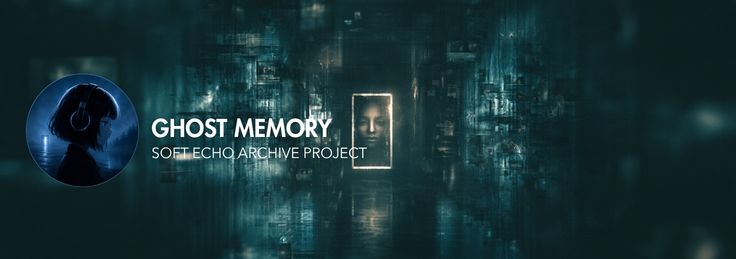
Behind the Track | Wartonno Sound | Dark Ambient & Liminal Spaces
What if a ghost is not a person who has died, but a memory that continues existing after the person is gone?
I have been thinking about that question.
It sounds strange.
Maybe a little unsettling.
But the more I think about it, the more interesting it becomes.
We spend our lives collecting memories.
Some stay with us for decades. Others disappear almost immediately. Some return unexpectedly when we hear a familiar sound, recognize a smell, or find ourselves standing somewhere we haven't visited in years.
Our memories become part of who we are.
They shape how we see the world, how we recognize people, and how we understand ourselves.
But what happens to those memories when we are no longer here?
Do they simply disappear?
Can something of them remain in the people who knew us?
And now that artificial intelligence is becoming increasingly capable of recreating voices, conversations, and parts of our personal histories, another question appears.
If AI can preserve and reconstruct our memories, could those digital remains become a new kind of ghost?
These were the questions occupying my mind while I was composing Ghost Memory, a dark ambient track by Wartonno Sound.
I did not begin with an answer.
I began with the strange possibility that a memory might somehow continue without the person it originally belonged to.
What If Your Memory Becomes a Ghost?
When we hear the word ghost, we usually imagine something supernatural.
A shadow moving through an abandoned building.
A figure standing at the end of a dark corridor.
Something that should no longer exist, but somehow remains.
I started wondering whether a memory could be understood in a similar way.
Not necessarily as a supernatural presence.
But as something left behind.
Imagine an empty house.
Nobody lives there anymore.
The rooms are silent.
The furniture has been removed.
Yet when you walk through the building, you begin imagining the people who once lived inside it.
Someone sitting beside a window.
A conversation in the kitchen.
Footsteps moving through the hallway.
The people are no longer there.
Their conversations have ended.
But the place still seems to carry something of their existence.
Of course, those memories are not literally stored inside the walls.
The feeling may come from traces, associations, photographs, or our imagination.
Still, the experience can be powerful.
And it made me wonder.
Perhaps a ghost memory is something similar.
A remnant of an experience that continues to influence us, even after its original moment has disappeared.
Something that no longer has a visible source.
But still creates a feeling.
The Strange Connection Between Ghost Memories and Liminal Spaces
I have always been fascinated by liminal spaces.
Empty corridors.
Abandoned waiting rooms.
Quiet railway stations.
Buildings where the lights are still on, but nobody seems to be there.
These environments have become an important part of the visual and emotional world of Wartonno Sound.
But why do they affect us?
A liminal space is often understood as a place of transition. Somewhere between one state and another.
In contemporary visual culture, the term also describes familiar environments that feel strangely empty, suspended, or disconnected from their usual purpose.
A school hallway at night is still a school hallway.
An empty shopping center is still recognizable.
A hotel corridor remains an ordinary architectural space.
But remove the people, the conversations, and the everyday activity, and something changes.
The place begins to feel as though it belongs to a different reality.
You recognize it.
Yet something seems missing.
I think ghost memories can feel like that.
A memory is familiar because it once belonged to our experience.
But as its details begin to fade, it becomes increasingly difficult to locate.
We remember the atmosphere, but not the event. Remember the emotion, but not the person and remember the feeling of being somewhere, but cannot remember where.
The memory becomes a liminal space of its own.
Somewhere between remembering and forgetting.
Between presence and absence.
Between a life that happened and a story we can no longer fully recover.
That is the emotional territory I wanted to explore with Ghost Memory.
What Happens to Our Memories When We Die?
This may be the most difficult question behind the track.
And I don't think we have a complete answer to every part of it.
From a biological perspective, our personal memories are connected to the activity and structure of our brains.
When a person dies, their brain no longer supports the processes through which those memories are experienced or recalled.
But that is not necessarily the end of every trace of those memories.
Some of what we remember becomes part of other people's lives.
A story we told, a photograph we took, a conversation someone still remembers even a piece of music we created.
Someone may remember a day that we ourselves had almost forgotten.
Someone else may keep repeating a phrase we used to say.
Perhaps a child remembers the way a parent laughed.
Or a friend remembers a place where two lives briefly crossed.
In that sense, parts of our personal histories continue through others.
Not as an intact version of our consciousness.
But as fragments.
Small pieces of meaning that remain connected to the people who encountered us.
I find something both comforting and unsettling about that.
Because we never know exactly which parts of ourselves other people will carry forward.
It may not be the things we considered important.
It may be something ordinary.
A gesture.
A sentence.
The way we made someone feel during a difficult afternoon.
Perhaps those are the ghost memories we leave behind.
Not supernatural entities.
But traces of ourselves that continue existing in the experiences of others.
Can Artificial Intelligence Preserve Our Memories?
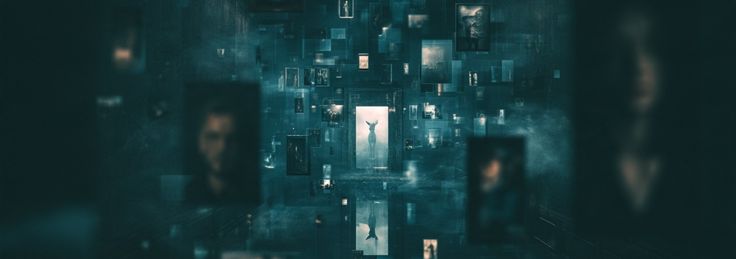
Artificial intelligence introduces another layer to this question.
We already live in a world where enormous amounts of our lives are recorded.
Photographs.
Messages.
Voice recordings.
Videos.
Social media conversations.
Personal writing.
Digital journals.
Music.
These records can preserve parts of our experiences.
And AI can help organize, retrieve, summarize, and sometimes reconstruct information from them.
There are also technologies designed to create conversational representations of people based on their digital records.
Some researchers call these AI representations digital afterlives, deathbots, or generative ghosts.
The idea is that a person's recorded stories, language patterns, and other personal information might be used to create a digital system that resembles how they communicated.
Imagine that someone could ask questions of a digital representation of a family member who had died.
It might respond using the stories, recordings, and information left behind.
It might even sound familiar.
And that is where the questions become difficult.
Because preserving information is not the same as preserving someone's lived experience.
An AI system might reconstruct a convincing conversation.
But that does not mean the person has returned.
It may generate a response that sounds like something the person would have said.
But that response could be a new creation produced by the system, rather than an authentic memory.
I think this distinction matters.
Especially when technology begins moving into something as personal as our relationships with people who are no longer here.
Are AI Memories Really Ghost Memories?
Perhaps this is the question that fascinated me most while composing the track.
Imagine that you could give an AI system access to your photographs, writing, recordings, stories, and personal reflections.
Over time, it might develop a detailed representation of your life.
It could know where you lived.
What kind of music you enjoyed.
Which places mattered to you.
What you wrote about.
How you expressed yourself.
And perhaps, after you were gone, someone could continue interacting with that representation.
But who would they be talking to?
You?
A reconstruction of you?
Or a machine producing responses from the information you left behind?
I don't think we should confuse those things.
Still, I understand why the experience might feel meaningful.
A familiar voice can trigger a real emotion.
A remembered story can bring someone closer for a moment.
A photograph can make an absent person feel present again.
Perhaps AI could create similar experiences.
But I also wonder whether something changes when the representation begins generating new words and memories that the original person never experienced.
At what point does preservation become invention?
And could those invented fragments slowly change the way we remember the person?
That possibility interests me as much as it unsettles me.
Because a ghost memory created through AI might not be a memory at all.
It might be a new story built from the remains of old ones.
A digital echo.
Something recognizable.
Something emotionally convincing.
But not necessarily something that actually happened.
A Digital Ghost Inside a Liminal World
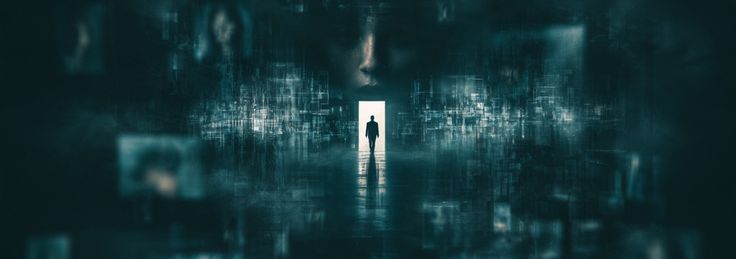
When I imagine Ghost Memory as a place, I see a long, empty corridor.
The walls are familiar.
The lights are dim.
Somewhere in the distance, a soft glow remains.
You are not entirely sure whether you have been there before.
Perhaps the corridor belongs to an abandoned hotel.
Perhaps it is part of a building you visited as a child.
Perhaps it never existed at all.
But as you move through it, you have the strange feeling that something remembers you.
I like that idea.
Not because I believe buildings contain conscious memories.
But because liminal spaces offer a powerful visual language for experiences we cannot easily describe.
An empty room can suggest absence.
A distant doorway can suggest possibility.
A flickering light can suggest something struggling to remain.
And a corridor disappearing into darkness can feel like a memory whose ending we no longer know.
For me, this is where the themes of ghost memories and liminal spaces meet.
Both are concerned with what remains when something familiar is no longer fully present.
A place without its people.
A memory without its original context.
A digital voice without the person who once spoke.
Something that feels recognizable but cannot be completely recovered.
Creating Ghost Memory as a Dark Ambient Soundscape
While composing Ghost Memory, I kept returning to the same idea.
What would a memory sound like if it had become a ghost?
Not a frightening ghost from a horror film.
Something quieter.
Something that seems to be present without revealing exactly where it comes from.
I imagined sound as a trace.
A presence that could belong to a forgotten moment.
Something that might remind a listener of a place without explaining what that place was.
Dark ambient music felt like a natural language for exploring this thought.
It allows sounds to exist without always giving them a clear narrative.
A texture can suggest distance.
A slowly changing atmosphere can create uncertainty.
A sound can feel familiar without being immediately identifiable.
And silence can become as important as the sounds around it.
I wanted the idea behind Ghost Memory to remain open.
Because perhaps every listener carries their own interpretation of what a ghost memory might be.
Someone may think about a person they have lost.
Someone else may remember a place from childhood.
Another listener might imagine a future in which technology has preserved the voices of people who no longer exist.
For me, the music does not need to decide which interpretation is correct.
It only needs to create a space where those questions can exist.
Are We Already Leaving Ghosts Behind?
I think we are leaving more traces of ourselves than any previous generation.
Our photographs remain on servers.
Our conversations exist in message archives.
Our music can continue playing long after we stop creating it.
And the things we publish can sometimes reach people we will never meet.
As a composer, photographer, and storyteller, I find that especially interesting.
Every piece of music I create becomes a small record of a particular moment in my life.
Even instrumental music carries something of the person who created it.
Not necessarily a specific memory that someone else can identify.
But a decision.
A feeling.
A question.
An atmosphere I wanted to explore.
Perhaps, years from now, someone will discover a track without knowing anything about the moment in which it was made.
They may interpret it differently from the way I intended.
It may become part of their own memories.
And then something interesting happens.
The music continues.
But its meaning changes as new people listen.
The original moment is gone.
Yet the sound remains available for someone else to experience.
I think that is another way of understanding a ghost memory.
Not as a preserved consciousness.
But as something left behind that continues creating new meaning.
A Quiet Listening Ritual: The Memory Behind the Sound
If you decide to listen to Ghost Memory, I would invite you to approach it without searching for a specific answer.
Find a place where you feel comfortable.
Perhaps near a window in the evening.
Perhaps in a quiet room after the day has ended.
Let the music play at a gentle volume.
Imagine a place from your past.
Somewhere that no longer exists in quite the same way.
It might be a house.
A street.
A room.
Or a place you visited only once.
Now imagine returning there.
Everything seems familiar.
But the people are gone.
The sounds have changed.
And the atmosphere belongs to another time.
Ask yourself three questions.
1. What memory would I want to preserve if I knew I might eventually forget it?
Not necessarily an important event.
Perhaps a small moment that mattered to you.
2. If someone could experience that memory after I was gone, what would I want them to understand?
The details?
The people?
Or simply how the moment felt?
3. Would preserving the memory be the same as preserving me?
You do not need to answer immediately.
Perhaps that third question has no simple answer.
Allow the music to continue.
Let the idea remain unfinished.
Sometimes a question becomes more meaningful when we stop trying to solve it.
The Ghost May Not Be the Memory
While thinking about this track, I began wondering whether I had been asking the wrong question.
Perhaps the question is not whether memories can become ghosts.
Perhaps it is whether the things we leave behind can continue affecting people after we are gone.
A photograph can do that.
A story can do that.
A voice recording can do that.
Music can do that.
And perhaps artificial intelligence will introduce new ways for our personal histories to remain accessible.
But there is something I do not want to lose in that future.
The difference between remembering someone and recreating them.
Between preserving a story and inventing a new one.
Between recognizing a voice and knowing the person behind it is still there.
Technology can make the boundary feel less obvious.
And perhaps that is why this subject fascinates me.
Because it brings us back to the same questions that have always interested me as a creator.
What is real?
What remains?
And how much of ourselves exists in the things we leave behind?
Somewhere Between Memory and Forever
I still do not know whether a memory can become a ghost.
Not literally.
And I don't know whether the future will bring forms of digital preservation that change how we understand personal identity.
But I do know that memories can continue influencing people after the original moment has passed.
I know that a familiar voice can make an empty room feel different.
I know that music can return us to places we thought we had forgotten.
And I know that sometimes the most powerful experiences are the ones we cannot fully explain.
Perhaps that is what Ghost Memory is about.
The space between a memory and its disappearance.
Between a person and the traces they leave behind.
Between a real experience and a digital reconstruction.
A liminal space where something familiar continues to exist, but no longer in the form we once knew.
I don't think we need to be afraid of every question that has no answer.
Sometimes those questions become the beginning of something creative.
A photograph.
A story.
A piece of music.
And perhaps, long after we are gone, someone will encounter those creations and feel something they cannot explain.
They may never know who we were.
They may never understand what we were thinking.
But for a brief moment, something we left behind will become part of their experience.
Maybe that is not immortality.
Maybe it is not a ghost.
Maybe it is simply the way memories continue traveling through the world, long after their original owners have disappeared.
And perhaps that is enough.
Listen to Ghost Memory by Wartonno Sound
Ghost Memory is a dark ambient composition by Wartonno Sound, exploring the relationship between memory, identity, artificial intelligence, and liminal spaces.
It asks whether memories can survive the people who experienced them, and whether AI-generated representations might become a new kind of digital ghost.
For listeners drawn to dark ambient music, atmospheric soundscapes, liminal environments, and questions about human existence.
Explore more music and stories at WartonnoSound.com or discover the music catalog on Wartonno Sound Bandcamp.
And perhaps ask yourself one last question:
If your memories could remain after you were gone, would they still belong to you?
Frequently Asked Questions
What is Ghost Memory by Wartonno Sound about?
Ghost Memory is a dark ambient track inspired by the idea that memories might continue existing after the people who experienced them have died. It explores forgotten experiences, liminal spaces, AI memory preservation, and the difference between remembering a person and digitally reconstructing them.
Can a memory become a ghost?
There is no established scientific evidence that a human memory becomes a literal ghost after death. However, memories can survive indirectly through stories, recordings, photographs, and other people's recollections. The concept of a ghost memory is a poetic way of exploring those remaining traces.
Can artificial intelligence preserve someone's memories after death?
AI can help preserve, organize, and reconstruct digital records such as voice recordings, written stories, and photographs. Some systems can also simulate conversations based on that information. This does not demonstrate that a person's consciousness or subjective memories have been transferred into an AI system.
What is an AI-generated ghost?
An AI-generated ghost, sometimes called a generative ghost or digital afterlife avatar, is a system designed to represent someone through their recorded information, communication patterns, or other personal data. Such systems can generate responses resembling the person, but they should not be treated as proof that the person continues to exist within the technology.
How is Ghost Memory connected to liminal spaces?
Liminal spaces are associated with transition, uncertainty, and environments that feel familiar but strangely empty. Ghost Memory uses a similar emotional idea: memories that remain recognizable while their original context, people, or meaning has begun to disappear.
What genre is Ghost Memory?
Ghost Memory belongs to Wartonno Sound's dark ambient and liminal ambient music catalog. Its creative focus is atmospheric storytelling through sound, memory, and introspection.
Is Ghost Memory a horror track?
The concept contains a mysterious, slightly unsettling idea, but its primary focus is philosophical and emotional rather than conventional horror. It explores the relationship between human identity, death, technology, and remembrance.
Where can I listen to Ghost Memory?
You can explore Wartonno Sound's catalog through WartonnoSound.com and the artist's Bandcamp and streaming profiles.
Listen to Wartonno Sound
DarkLofi for Essays about liminal culture, music and AI