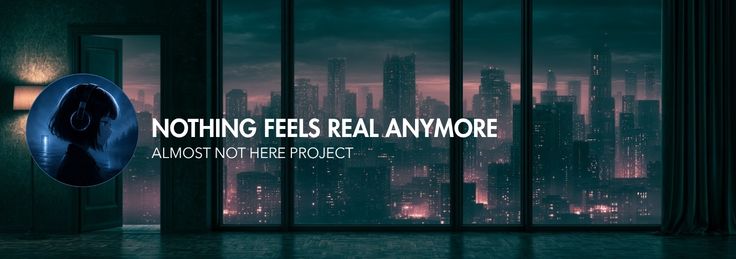
Almost Not Here, Part 1 | Behind the Track | Wartonno Sound
Somewhere between what we recognize and what we no longer understand, something begins to feel different.
I have been thinking about that for a long time.
Not only in music. In almost everything around us.
We live in a world where artificial intelligence can create images, voices, stories, conversations, and music. Things that once felt deeply connected to human experience can now emerge from a machine.
I am not against artificial intelligence.
I find much of it fascinating. I see the creative possibilities. I understand why artists use it, experiment with it, and sometimes build entirely new worlds around it.
But there is a question I keep returning to.
When something looks, sounds, and feels real, how do we know what we are experiencing?
And perhaps an even more difficult question:
Does it matter how something was made if the feeling it creates inside us is real?
These questions were part of the beginning of Nothing Feels Real Anymore, a dark ambient track released by Wartonno Sound on October 9, 2026, through DistroKid.
It is also the first chapter of Almost Not Here, a series about emotional distance, disconnection, isolation, and the strange relationship between ourselves and the world we recognize.
But for me, the story begins somewhere else.
With a thought that would not let me sleep.
The Question That Kept Returning at Night
I believe the idea for Nothing Feels Real Anymore began when AI music and other forms of artificial intelligence started becoming part of everyday creative life.
Suddenly, the boundaries were changing.
A beautiful image no longer necessarily came from a photographer holding a camera.
A convincing voice no longer necessarily belonged to someone singing in a recording studio.
A piece of music no longer necessarily began with a person playing an instrument or composing a melody in the familiar way.
I found myself looking at creative work differently.
Not because I wanted to judge it.
Because I wanted to understand it.
Was this made by a human being? Was it generated by AI? Was it something created through a combination of human decisions and machine-generated material?
And why did I suddenly feel the need to know?
For years, I have been drawn to creating things. Music, photography, stories, visuals, and imaginary places. I enjoy the process of taking something that exists only as a feeling or idea and slowly giving it a form.
Technology has always been part of that process.
But AI seemed to introduce a different question.
It was no longer only about what technology could help us create.
It was about whether we could still recognize the difference between the familiar and the unfamiliar.
Sometimes I would lie awake thinking about it.
If a song moves me, is that emotion less meaningful if I discover it was generated?
If an image makes me remember a place I have never visited, does the origin of that image change my experience?
If something can imitate human creativity so convincingly, what does that make me feel about my own creativity?
I did not have answers.
I still do not have complete answers.
And maybe that uncertainty was exactly what needed to become music.
Is AI-Generated Music Real Music?
I think AI-generated music can be real music.
After all, the sound exists. Someone can hear it. Someone can attach a memory to it. Someone can find something meaningful inside it.
The emotional response of the listener does not automatically disappear because the production process involved artificial intelligence.
But that does not mean every question about AI music becomes irrelevant.
There is still authorship.
There is intention.
There is consent, originality, creative ownership, and the relationship between an artist and a listener.
Those things matter to me.
I do not think we need to choose between blindly celebrating every new technology and rejecting it completely.
There is a space between those positions.
A space where we can remain curious without giving up our questions.
I think that is where this track lives.
Nothing Feels Real Anymore is not a protest against AI.
It is not a statement that human-made art is automatically better.
It is an attempt to express what happens when our understanding of creativity starts shifting.
And when that shift becomes personal.
Because sometimes the question changes from Is this real? to something much closer.
Why does this make me question myself?
Creating Music Between the Familiar and the Unknown
When I started creating Nothing Feels Real Anymore, I wanted the music to carry the same uncertainty I had been thinking about.
I began searching for two different kinds of sound.
The first kind was recognizable.
Sounds that feel familiar almost immediately. Something you might connect to a room, an environment, a memory, or an experience you already understand.
The second kind was different.
Droning sounds that were harder to identify.
Textures without an obvious source.
Sounds that might remind you of something, but never completely reveal what that something is.
My goal was to bring those two worlds together.
Not to make one defeat the other.
To see whether they could coexist.
I wanted to find a kind of synergy between sounds we recognize and sounds that seem to arrive from somewhere we cannot identify.
That became one of the central ideas of the track.
A familiar sound can offer a small point of orientation.
You hear it and think you know where you are.
Then another layer enters.
Something less certain.
The recognizable sound is still there, but the space around it has changed.
I find that interesting because it resembles the way I sometimes experience the changing world around me.
The same world is still here.
The same streets. The same rooms. The same people.
But the things we use to understand that world are changing.
And sometimes those changes are difficult to describe.
Music gives me another way to approach them.
Without having to explain everything.
Why Dark Ambient Felt Like the Right Language
Dark ambient music offers something I have always found valuable.
It does not need to tell you exactly what to feel.
There does not have to be an obvious melody leading you toward a particular emotion. There does not have to be a rhythm telling you where the next moment belongs.
Sometimes a sound can simply remain.
A low drone.
A distant texture.
An almost recognizable movement somewhere in the background.
And because the music leaves space, the listener begins to bring something of themselves into it.
Their memories.
Their thoughts.
Their uncertainties.
This is one of the reasons I continue creating dark and liminal ambient music through Wartonno Sound.
I am interested in the spaces between things.
Between sleep and waking.
Between memory and imagination.
Between the sound of a familiar place and the feeling that something within that place has changed.
The place of AI music in our world
Nothing Feels Real Anymore belongs to that world.
But it also introduces a question I have not explored in quite the same way before.
What happens when the uncertainty is no longer only about the place around us?
What happens when it is about our understanding of what is human?
When the World Changes the Way We See Ourselves
There is something I want listeners to take away from Almost Not Here.
Not an answer.
A question directed inward.
How are you?
It sounds simple.
It is something we ask each other all the time.
But how often do we give ourselves enough space to answer it?
How do you really feel?
Are you comfortable with the things happening around you?
Are you excited by the changes in the world?
Are you uncertain about them?
And when something feels different inside you, how do you know where that feeling comes from?
I think we sometimes forget how much the outside world influences the way we experience ourselves.
Technology changes our routines.
Social platforms change how we compare our lives.
Artificial intelligence changes what we expect from creativity, communication, and even our own abilities.
These changes can open possibilities.
They can also introduce questions we have not learned to live with yet.
I am not suggesting that AI is making the world unreal.
The world is still here.
But our interpretation of it can change.
And with that, our sense of who we are may change as well.
I find that both fascinating and unsettling.
That tension is part of the emotional landscape I wanted to explore with this music.
Explore the Almost Not Here series
What Does It Mean When Nothing Feels Real Anymore?
The title can mean different things.
For some people, it might describe emotional exhaustion.
For others, it might recall a moment when familiar surroundings suddenly felt strange or distant.
There are also experiences described as derealization, in which a person feels detached from their surroundings or perceives the outside world as unreal. Derealization is a recognized psychological experience, although a feeling of uncertainty about technology or society is not the same thing as having a clinical symptom.
For me, the title has another layer.
It describes the difficulty of knowing what to trust in a world where the boundaries between human-created and machine-generated experiences are becoming less obvious.
I can recognize the sound of a piano.
But I may not know whether a person played it.
I can recognize a human voice.
But I may not know whether that voice belongs to a real singer.
I can recognize the shape of a photograph.
But I may not know whether the place inside it ever existed.
That does something to the way I approach creative work.
Not always negatively.
Sometimes it creates curiosity.
Sometimes wonder.
Sometimes a new idea.
And sometimes it leaves me with a strange feeling I cannot immediately explain.
That is the feeling I wanted to give a musical shape.
Not by recreating artificial intelligence through sound.
But by placing recognizable and unfamiliar sonic elements together, allowing them to exist inside the same atmosphere.
Almost Not Here: A Series About Distance and Identity
Nothing Feels Real Anymore is part of a larger project called Almost Not Here.
The series explores the experience of being physically present while feeling increasingly distant from yourself or your surroundings.
Every track approaches that idea from a different direction.
Nothing Feels Real Anymore begins with uncertainty.
It asks what happens when the world feels familiar but no longer entirely understandable.
Fading Signal moves toward emotional withdrawal. It explores the desire to become harder to reach, almost like a transmission slowly disappearing into static.
Distant Interior moves further inward. It explores the uncomfortable feeling that even familiar spaces can seem emotionally distant.
Together, these tracks form an unfolding journey.
They are connected by dark ambient textures, emotional distance, and the atmosphere of places that seem caught between presence and absence.
But I do not want the series to be only about disappearing.
Because there is another part of the idea that matters just as much.
Something remains.
Even when the world feels different.
Even when you feel disconnected.
Even when you cannot immediately explain your own reaction to what is happening around you.
There is still someone asking the questions.
And that someone is you.
A Small Listening Ritual: Return to Your Own Questions
I do not create music to tell people how they should feel.
I do not believe a soundscape can solve every difficult thought or uncertainty.
But music can offer a place to spend a few minutes with those thoughts, without demanding an immediate answer.
If you listen to Nothing Feels Real Anymore, perhaps you can approach it this way.
Find a place where you feel comfortable.
It does not need to be completely silent.
Put on the track at a volume that feels natural.
Listen for something recognizable.
A sound or texture that reminds you of something you already know.
Then notice what happens when another sound becomes more difficult to identify.
You do not need to understand where every layer comes from.
You do not even need to like every sound.
Just observe the way your attention moves between familiarity and uncertainty.
When the track finishes, ask yourself three questions:
- What feels familiar in my life right now?
- What has changed around me that I am still trying to understand?
- How do I feel about myself inside those changes?
You do not have to write down the answers.
You do not have to find a solution.
Sometimes recognizing the question is enough for that moment.
Something Remains
I started Nothing Feels Real Anymore because I was thinking about artificial intelligence and the changing nature of creativity.
But while working on the track, I began to realize that the subject was larger than AI.
It was about perception.
Trust.
Identity.
And the quiet uncertainty that can appear when a world we thought we understood begins to change.
I still use technology in my creative life.
I am still interested in what artificial intelligence can make possible.
And I still believe there is room for new forms of art that combine human imagination with emerging tools.
But I also want to remain aware of what those changes do to us.
Not just as creators.
As people.
Because the most important question may not be whether a machine can produce something that feels human.
It may be whether we continue taking the time to understand our own human experiences.
How we feel.
What we recognize.
What we believe.
And what we want to remain real in our lives.
That is where this first chapter of Almost Not Here ends.
Not with certainty.
But with an invitation to look inward.
The world may be changing the way you understand reality.
But somewhere inside that changing world, you are still here.
And perhaps that is where the next question begins.
Listen to Nothing Feels Real Anymore
Nothing Feels Real Anymore is a dark ambient release by Wartonno Sound, distributed through DistroKid on October 9, 2026.
It is the first chapter of the Almost Not Here series, exploring AI, human identity, unfamiliar sounds, and the feeling of disconnection from a changing world.
Explore the full project at:
And if this story connects with something you have been thinking about, I would be interested to know:
When was the last time the world changed something about the way you see yourself?
Frequently Asked Questions
What is Nothing Feels Real Anymore by Wartonno Sound about?
Nothing Feels Real Anymore is a dark ambient track exploring uncertainty about reality, artificial intelligence, human creativity, and identity. It combines recognizable sounds with unfamiliar droning textures to express the tension between what we know and what we struggle to understand.
When was Nothing Feels Real Anymore released?
The DistroKid-distributed release of Nothing Feels Real Anymore is dated October 9, 2026. The track is part of Wartonno Sound’s Almost Not Here project.
What is the Almost Not Here project?
Almost Not Here is a dark ambient music series created by Wartonno Sound. It explores emotional disconnection, isolation, derealization as an artistic theme, identity, and the feeling of becoming distant from the outside world.
Is Nothing Feels Real Anymore an anti-AI song?
No. The track does not reject artificial intelligence. It explores the personal uncertainty that can arise when AI changes how we recognize creativity, authenticity, and human expression.
What kind of music is Nothing Feels Real Anymore?
It is dark ambient music with a liminal, atmospheric approach. Its creative concept involves combining familiar sonic elements with unfamiliar drone-based textures.
What is the difference between feeling disconnected and derealization?
Feeling disconnected is a broad everyday description of emotional or perceptual distance. Derealization refers more specifically to an experience in which surroundings may feel unreal or detached. The track uses these experiences as creative themes and is not intended as a clinical treatment.
Who created Nothing Feels Real Anymore?
Nothing Feels Real Anymore was created by Wartonno Sound, the dark ambient music project of composer and creator Wartonno.
Where can I listen to Almost Not Here?
The project is available through Wartonno Sound’s SoundCloud and Bandcamp listening links, with selected tracks distributed to other streaming services. The project’s central listening page is wartonnosound.com/almost-not-here/.