
You are tired all evening.
You tell yourself you will go to bed early.
Then your head finally touches the pillow.
And suddenly your brain decides this is the perfect moment to remember everything.
A conversation from three days ago.
Something you need to do tomorrow.
A decision you still haven’t made.
A strange thing you said in 2017 that apparently requires immediate investigation.
During the day, none of it seemed quite so important.
At night, it can fill the entire room.
If this happens to you, there is a fairly simple reason why.
And understanding it may be more useful than trying to force yourself to stop thinking.
Why Does My Mind Start Racing When I Go to Bed?
During the day, your attention has somewhere to go.
There are messages.
Work.
Music.
People.
Traffic.
Television.
Your phone.
Small decisions that keep arriving one after another.
Then you go to bed.
The light disappears.
The room becomes quiet.
Most of those external distractions are suddenly gone.
What remains is you and whatever was already moving around inside your head.
Sleep specialists describe this as one reason worries and racing thoughts can become more noticeable at bedtime. Research also connects pre-sleep cognitive activity, including planning, worrying and problem-solving, with difficulty falling asleep.
I sometimes think of it differently.
The thoughts were probably already there.
The night simply gave them an empty room.
If this is a familiar part of your nights, I have collected the related Wartonno Sound music, listening rituals and quiet tools in one place.
Why Do Thoughts Feel More Important at Night?
A thought at 2PM has competition.
A thought at midnight doesn’t.
That unfinished email suddenly feels important.
Tomorrow’s problem feels as though it should be solved tonight.
You replay a conversation, looking for a different answer.
Then another thought appears behind it.
And another.
Before long, you are not resting.
You are having a meeting with yourself in the dark.
This can become a loop.
You notice that you are thinking.
You become frustrated because you are supposed to be sleeping.
Now you are thinking about the fact that you are thinking.
And somehow “I should be asleep” becomes one more thing keeping you awake.
The bed itself can even begin to become associated with worrying when the same pattern happens repeatedly.
That is why my first suggestion is not:
Stop thinking.
I don’t find that particularly useful.
Instead, I prefer:
Give the mind something quieter to do.

5 Things to Try When You Start Overthinking at Night
These are deliberately simple.
You do not need to turn your evening into a complicated wellness routine.
The whole point is to remove stimulation, not add another project.
1. Stop Asking Yourself to Solve Tomorrow Tonight
This sounds obvious.
It doesn’t always feel obvious at midnight.
When a problem enters your mind, ask:
Does this actually need an answer tonight?
Usually, it doesn’t.
Tomorrow-you will have daylight, context and probably coffee.
Tonight-you has a pillow.
Those are different working conditions.
If something really does need remembering, write it down.
Then allow the page to carry it until morning.
You haven’t ignored the thought.
You have simply given it another appointment.
2. Write Down What Feels Loud
You don’t need to journal for twenty minutes.
Take a piece of paper.
Write:
What feels loud tonight?
Then answer in a few words.
Maybe:
Tomorrow’s meeting.
Money.
I shouldn’t have said that.
I still haven’t finished the project.
I don’t know what comes next.
Don’t immediately turn those answers into another analysis session.
Just put them somewhere outside your head.
For me, this is one of the reasons a small physical tracker works better than trying to do everything mentally.
The page gives the thought somewhere else to exist.
3. Replace Scrolling With One Quiet Thing
I understand the temptation to reach for the phone.
You aren’t sleeping anyway.
You might as well look at something.
Except one video becomes another.
One notification becomes a message.
A message becomes checking something else.
Before long, your tired mind has received another hundred pieces of information.
If possible, replace that endless stream with one thing that doesn’t keep changing.
A book.
A notebook.
A familiar soundscape.
One piece of ambient music.
The important word is one.
At this point in the evening, I am not looking for more information.
I am looking for less.
4. Try Repetition Instead of More Stimulation
This is where music becomes useful for me.
Not because music magically removes thoughts.
It doesn’t.
But a quiet, repetitive sound can give attention a stable place to rest.
There is nothing new to investigate.
Nothing suddenly demanding a response.
You already know what is coming.
That is the thinking behind my track Overthinking at 3AM.
It is a two-minute dark ambient piece created for that strange part of the night when everything around you has stopped but your mind hasn’t.
The track doesn’t try to overpower the thoughts.
It simply occupies some of the silence around them.
You can read more about Overthinking at 3AM, part of my Quiet Rooms series, here.
5. Give Yourself Ten Minutes Instead of an Entire New Routine
This became the basis for another ritual I created.
Two minutes of music.
Repeated five times.
Ten minutes.
Before you begin, write down:
What feels loud tonight?
Then listen.
Afterwards ask:
What can wait until tomorrow?
That’s it.
No thirty-day challenge.
No complicated morning-and-evening system.
No requirement to become excellent at relaxing.
Just ten quieter minutes between the day and whatever comes next.
I wrote the complete ritual in:
Can’t Stop Thinking at Night? Try This 10-Minute Quiet Listening Ritual
You Don’t Have to Finish Every Thought
I think this is the part we often forget.
A thought appearing does not mean you have to follow it.
A question appearing does not mean you need to answer it.
A memory appearing does not mean you need to reopen it.
Sometimes the mind produces unfinished things because that is what minds do.
You can notice them without turning every one of them into tonight’s work.
That doesn’t mean the thoughts disappear.
It creates a little space around them.
And sometimes that is enough for now.
Turn the Music Into a Small Nighttime Ritual
I created the Overthinking at 3AM Quiet Loop Tracker for people who want something physical to use alongside the music.
It combines:
- the original two-minute Overthinking at 3AM ambient track
- a simple nighttime listening ritual
- a printable Quiet Loop Tracker
- reflection prompts
- space to notice what feels loud
- space to decide what can wait until tomorrow
It isn’t designed to turn sleep into something else you need to measure perfectly.
The tracker is there to help you notice patterns and give unfinished thoughts somewhere to land.
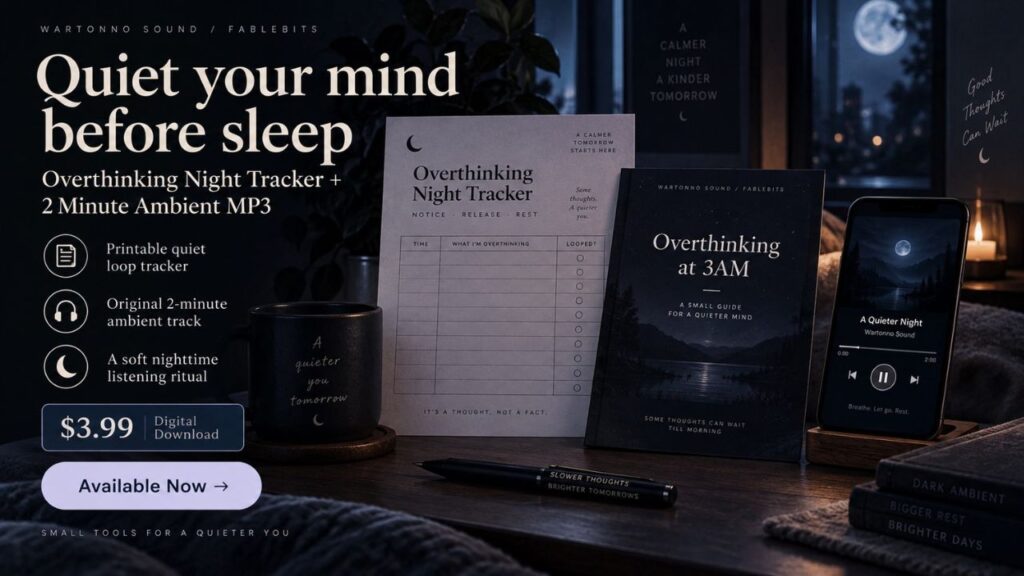
Overthinking at 3AM Quiet Loop Tracker
For nights when the world is quiet but your mind is still working.
Listen. Repeat. Notice. Leave one thought behind.
Explore the Quiet Loop Tracker
Want Something Quieter in Your Inbox?
When Overthinking Turns Into Something More
An occasional busy mind at bedtime is common.
But if racing thoughts, worry or difficulty sleeping regularly interfere with your nights or your daily life, it is worth discussing that with a healthcare professional rather than relying only on music, journaling or nighttime routines. Sleep specialists make the same distinction between occasional nighttime worry and persistent problems that need more attention.
Wartonno Sound isn’t therapy or a sleep treatment.
The music offers something much simpler.
A quieter environment.
A place for your attention to rest for a moment.
Sometimes that is exactly what I am looking for.
Frequently Asked Questions
Why do I suddenly start overthinking when I go to bed?
One reason is that daytime distractions disappear when you lie down. With fewer external demands on your attention, worries, plans and unfinished thoughts can become more noticeable. Pre-sleep thinking and cognitive arousal are also associated with difficulty falling asleep.
Why does everything seem worse at night?
Thoughts can feel larger when there is little else competing for your attention. Stress and tiredness can also make nighttime worry harder to disengage from. That does not necessarily mean the problem itself has become more important.
What can I do when I can’t stop thinking before bed?
Keep it simple. Reduce stimulation, write down what is occupying your mind, give tomorrow’s tasks somewhere to wait, and choose one quiet activity such as reading or listening to low-stimulation music.
Can ambient music help with overthinking?
Ambient music should not be presented as a treatment for anxiety or insomnia. Some people find a quiet, repetitive soundscape useful because it gives their attention an external focus without demanding much engagement. Wartonno Sound uses ambient music in exactly this way: as an environment rather than a promised solution.
What is Overthinking at 3AM?
Overthinking at 3AM is a dark ambient track by Wartonno Sound created around the experience of being physically tired while thoughts continue moving. It belongs to the Quiet Rooms series and is intended for nighttime listening, journaling, reading and reflection.
What is a Quiet Loop Tracker?
The Quiet Loop Tracker combines a short piece of music with repeated listening and simple written reflection. The Overthinking at 3AM version uses the two-minute track across a suggested ten-minute ritual.
Some Thoughts Can Wait Until Morning
The room becomes quiet.
Your mind doesn’t always follow immediately.
That is okay.
Maybe the goal isn’t to empty your head before sleep.
Maybe it is simply to stop treating every thought as something that needs your attention right now.
Write one down.
Let one go.
Put on something quiet.
Leave tomorrow where it belongs.
For the mind that keeps moving after the world goes quiet.
If you want to continue from here, visit the Overthinking at Night collection for ambient music, a 10-minute listening ritual, Overthinking at 3AM and longer quiet listening sessions.
Wartonno Sound